
Livonia Previous Residents by Era
There is no single list of previous residents for a Livonia home. The sound method changes with the date. Recent land instruments can identify the parties to a transfer. A 1950 local telephone book can supply a dated name-and-address clue. Earlier regional directories and census schedules help reconstruct a household, while newspapers, obituaries, cemetery transcriptions, and probate files can explain a move or an estate conveyance. The table separates confirmed local and county sources from the gaps that require a counter, mail request, or catalog search.
| Source | Years It Covers | Where Held | What It Shows |
|---|---|---|---|
| Wayne deed web index | January 1, 1960 to current online index | Wayne Register of Deeds / Wayne Public Search | Grantor, grantee, instrument date, and document or liber-page reference |
| Wayne land-record archive | County states records reach 1703 | Wayne Register of Deeds books, tract books, and archives | Earlier deeds, mortgages, plats, and legal descriptions |
| Livonia telephone directory sample | November 1950 | Farmington Community Library Heritage Collection | Names, local addresses, four-digit numbers, and occasional occupation text |
| Detroit city directories at Livonia Library | 1880-81 through 1940-41, in confirmed runs | Bennett Civic Center microfilm | Regional address and name trail, not a complete Livonia-only sequence |
| Livonia newspaper and obituary material | Newspapers 1955-2014; obituary index 1955-2014 with 2015-present updates | Livonia Public Library | Moves, death notices, family, and civic or property leads |
| Federal census microfilm | Michigan runs 1830-1930; release timing follows the federal 72-year rule | Livonia Public Library and federal repositories | Household composition and geographic context |
Start with the instrument route when a known address has a modern parcel record. Start with the telephone directory, newspaper, or census when the question is about a mid-century household. Building, inspection, and permit records may provide dates through Livonia BS&A or a city request, but an online start year for those series was not located in the reviewed sources.
Livonia Parcel Records Before Deeds
Before working backward, pin down the address as it exists now. The Livonia Online Property Inquiry links to the city’s BS&A property search and parcel map. The city advises searchers to omit a road suffix in some address searches. BS&A can search by address, name, parcel number, utility billing account number, or building department record number. For a house-history trail, record the current situs address, parcel or PIN, legal description, tax year, and owner or entity as displayed.
The Livonia parcel map supplies the spatial half of that record. Its layers include Tax Parcels, Address Text, Parcel Full PIN Text, Parcel Lot Text, subdivision boundaries, and road layers. The public map can help confirm which lot belongs to the address, but it is not a list of past residents. A tax-roll mailing address can also differ from the physical address, so neither it nor the current owner alone proves who lived in the home at an earlier date.
Livonia Deed Records Boundary
The online window is the key local records quirk. Wayne County says its land-record archive reaches to 1703, but the public web index begins January 1, 1960. That means the online search can be a fast starting point for later transfers, while an earlier chain must move to the Register of Deeds office, a mail search, deed books, tract books, plats, or archive material. Do not interpret the online cutoff as the first date a Livonia property existed or changed hands.
The Wayne Public Search landing page shows the current Register of Deeds search and Property Alert routes.
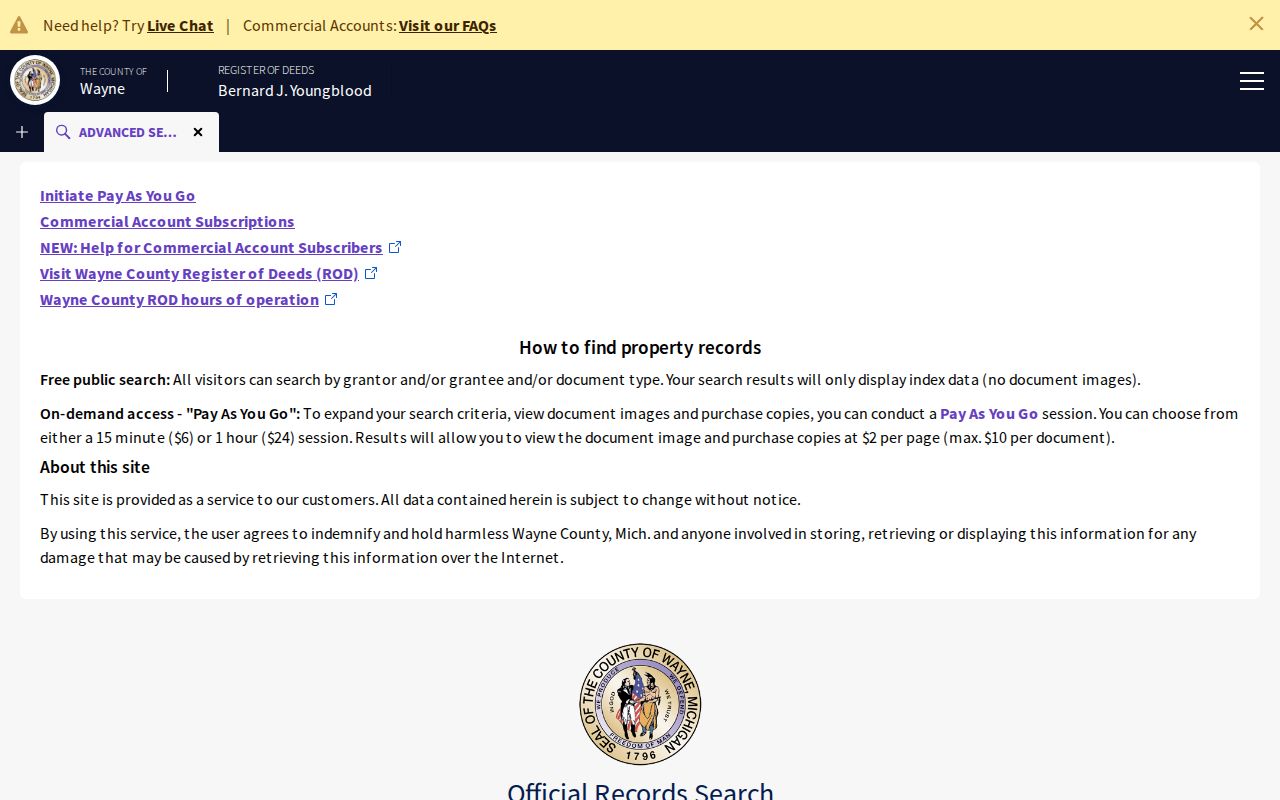
Use the portal as an index to parties and instruments. The free public search is limited to a grantor or grantee name. A paid account expands the route to address, legal description, parcel or tax ID, liber/page, and document details. Property Alert can monitor a name or keyword in new real-property filings, but it is an alert service, not a complete title history.
Note: Since October 2025, an in-person Wayne Register of Deeds search requires an appointment before visiting the Detroit office.
Tracing Livonia Previous Residents in Deeds
Follow the deed chain from a current parcel toward earlier transfers. At each link, verify the legal description or PIN rather than assuming a similar street address is the same property. A seller may be an estate, trust, organization, or a group of co-owners. Keep every party and document type in the notes until the next purchase relationship is clear. A deed chain identifies transfers and parties to them; it does not by itself establish every person who lived in the house.
- Use BS&A and the parcel map to record the current owner or entity, parcel or PIN, and legal description.
- Search the current owner as grantee in Wayne Public Search to locate the purchase instrument.
- Record the grantor, recording date, document number or liber/page, and instrument type from that result.
- Search that earlier grantor as grantee, then confirm the same legal description before treating it as the prior purchase.
- Repeat backward. At the 1960 web boundary, request an office or mail search and carry forward the legal description, plat, and liber/page references.
Wayne County’s grantor-grantee search instructions explain the limited free name index and the paid address, legal-description, and document route.
For an office or mail search, the county requests the property address and uses the same Register of Deeds system. The research documents a $15 mail-search fee, $2 per page for copies, and $10 per document for certification in the county instructions. Search and copy charges are distinct from the 2026 recording fee.
- Grantor
- The party transferring an interest in an instrument, often the seller named on a deed.
- Grantee
- The party receiving that interest, often the buyer named on a deed.
- Chain of title
- The dated sequence of property transfers traced from one instrument to the next.
- Legal description
- The lot, block, subdivision, or metes-and-bounds wording that identifies the land more reliably than a changing street address.
Livonia Address Record Continuity
Historic place names can break an otherwise careful search. Before incorporation in 1950, relevant records may use Livonia Township, Livonia Center, Clarenceville, or a village reference. Newburg and Newburgh are especially important variants. The former Newburg village at Ann Arbor Trail dates to 1819, and Livonia’s road history notes historic spelling differences. Search both forms in an old deed, newspaper, cemetery record, or directory, then connect results through the parcel, lot, block, subdivision, or nearby road.
The road material also notes that Middle Belt may appear as “Middlebelt.” Preserve a record’s original street form in the notes, even after normalizing it for a modern search. No official source reviewed for Livonia identified a citywide street-renumbering project or a comprehensive renumbering year. A mismatch therefore calls for a spelling and legal-description check, not an invented conversion rule.
Livonia Households in Directories and Census
Ownership is only part of a previous-residents question. The household layer comes from dated directories, telephone books, census schedules, newspaper notices, and obituaries. The 1950 Livonia telephone directory is a 25-page local booklet with names, addresses, four-digit local numbers, and occasional title or occupation text. Detroit directory microfilm at the Livonia library is useful regional context, but it must not be represented as a complete Livonia series. The confirmed collections themselves are detailed in the Livonia city directories section.
- Choose the closest dated directory, telephone book, or newspaper index to the transfer period.
- Search by surname, then compare the printed address, initials, title, and street spelling.
- For a criss-cross or street-order volume, check the house number to find the listed head of household.
- Pair the address with the nearest released federal census and compare the household composition.
- Use the Livonia Observer obituary index, cemetery transcriptions, or probate and deed records to test whether a move or death explains the next gap.
The Livonia library’s newspaper microfilm runs from July 7, 1955 through December 31, 2014, but September through December 1979 is missing. The gap is a collection limitation, not proof that the address had no relevant notice. The 2015-present obituary index is updated quarterly, and mail obituary research costs $10 per name with a date of death.
Livonia Estate Record Endpoints
When a final recorded owner has died, return from the address to the person carefully. A Livonia obituary index can point to a death notice; Wayne probate or court records may then identify an estate route; a later deed can show a conveyance by heirs, a personal representative, a trust, or another entity. This sequence explains a transfer without assuming that a surname match represents the same person. It also keeps family relationships in their original record context.
Greenmead’s historical resources provide cemetery transcriptions, village history, road history, maps, and older newspaper material. Clarenceville and Newburg cemetery documents reflect repeated readings and retypings across decades. A transcription is useful evidence of an inscription and family context, but it is not a live burial database. For early land research, pair the cemetery lead with the 1876 Wayne County Patron Directory, legal description, and county deed records.
Livonia Previous Residents Record Limits
Livonia has no dedicated official house-history report that combines every source. The practical support system is distributed among the library’s genealogy material, Greenmead’s historical resources, the city parcel tools, and the Wayne Register of Deeds. Sanborn fire-insurance map coverage for a specific Livonia year was not located in the inspected city or library pages. Search the Library of Congress and Library of Michigan catalogs by Livonia, Wayne County, Detroit, and subdivision before relying on a map series.
Permit and utility material also has limits. BS&A may expose a building, enforcement, certificate, or project reference when that service publishes it, while a missing series can be requested from the city through Michigan FOIA. Utility customer names and account lists are not public. Ask for a defined public record type, date range, and parcel or PIN instead of seeking private household information.
Lawful use. Use Livonia previous-resident records for family history, house history, estate questions, or personal curiosity. Do not use historical or address information to stalk, harass, or harm a living person.
Note: A transparent gap is better than a guessed household match, especially when a record changes custody or an address spelling changes.